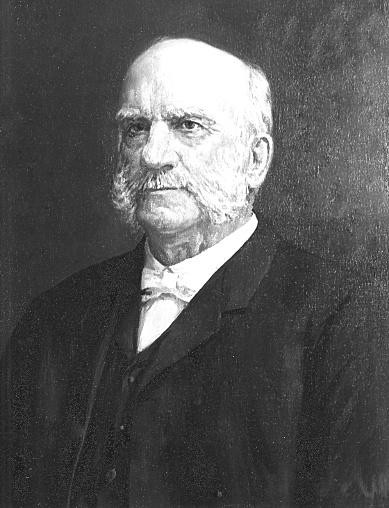
Artist: Robert Wadsworth Grafton (1876–1936)
Seaman Asahel Knapp
KNAPP, SEAMAN ASAHEL (1833–1911), inducted between 1920–1936
Unlike most of the Saddle & Sirloin inductees, Seaman Knapp began his pursuit of agriculture somewhat later in life, and he entered the field with a unique entrepreneurial and strategic spirit. Born and educated in Schroon Lake, New York, his first career was as a college teacher in that state. In 1866, he moved to Iowa, where he headed the Iowa College for the Blind and established a stock farm. He became interested in testing improved farming methods there, and by the 1870s, Dr. Knapp had organized the Iowa Improved Stock Breeders Association and founded the Western Stock Journal and Farmer newspaper. He was asked to lead the agriculture program at Iowa State College in 1879, where he also served a one-year term as college president. Dr. Knapp established the forerunner of the demonstration farm on Iowa State’s campus, and in 1882, drafted a bill to seek federal funding for experimental farming stations—the foundations of the Hatch Act.
From 1886 to 1898, Dr. Knapp worked for the North American Land and Timber Company of Great Britain, developing the rice industry in Louisiana and encouraging northern farmers to relocate there and adopt his improved farming practices. The US Department of Agriculture then hired him to promote improvements and diversification in the Southern United States, so he traveled to China, Japan, and the Philippines, learning new farming methods. When the cotton boll weevil began to destroy crops in the South, Seaman Knapp established a demonstration farm in Terrell, Texas. Success there led the USDA to hire several farm demonstration agents throughout the region—the foundations of cooperative extension work. To promote the demonstration farming plan, Knapp organized boys’ and girls’ cotton and corn growing clubs—one of the forerunners of 4-H. Dr. Seaman Knapp’s initiative and innovation produced lasting contributions to agricultural education. In 1984, this “father of extension work” was honored by the National Agricultural Hall of Fame. Artist Robert Grafton painted a portrait of his son Herman for Iowa State College in 1935, so the father’s portrait may have been completed about the same time.
Source: Saddle & Sirloin Guidebook 2026, p. 123