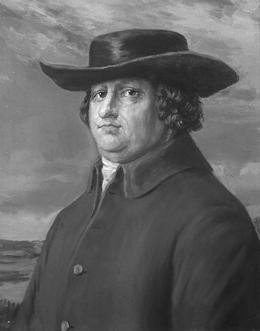
Artist: Robert Wadsworth Grafton (1876–1936); original portrait by James R. Stuart
Robert Bakewell
BAKEWELL, ROBERT (1725–1795), inducted 1903
Robert Bakewell was an English agriculturalist who revolutionized stockbreeding, transforming the quality of Britain’s cattle, sheep, and horses. Born on a tenant farm in Dishley, Leicestershire, the young Bakewell traveled extensively to observe agricultural techniques and to study the anatomy of animals. After apprenticing with his father, he began to pioneer many innovative practices with grassland irrigation, crop rotation, and test plots with varied manures and flooding methods. His most influential experiments, however, involved the selective breeding of cattle and sheep; so influential, in fact, that Charles Darwin cited them in his landmark work, On the Origin of Species.
Bakewell was the first to separate males from females, allowing mating only deliberately. By selecting animals with desired characteristics and mating near relatives with the same desired characteristics, he proved that line breeding could fix type. Robert Bakewell was first to breed cattle and sheep for meat production and the first to lease animals for stud fees. In 1783 he established the Dishley Society to protect the purity of his stock—the forerunner of breed associations. Bakewell’s daring advancements earned the attention of King George III in his time and the respect of the men of the Saddle & Sirloin Club one hundred years later. His portrait was one of the first assigned to painter James R. Stuart when the collection was established.
Source: Saddle & Sirloin Guidebook 2026, p. 44