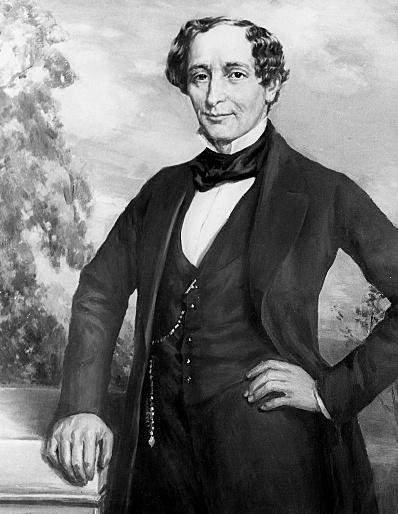
Artist: Robert Wadsworth Grafton (1876–1936); original portrait by James R. Stuart
Robert Aitcheson Alexander
ALEXANDER, ROBERT AITCHESON (1819–1867), inducted 1903
Robert S. C. (Spreul Crawford) Aitcheson Alexander was born in Frankfort, Kentucky, and raised on Woodburn, the farm his father established in Woodford County. He enrolled in Trinity College, the University of Cambridge, England, around 1837. While abroad, Alexander inherited the estate of his Scottish uncle, and was transformed, overnight, into one of the wealthiest men in the world. He returned to Kentucky in 1849 and used his financial resources to establish Woodburn Stud as a leading Thoroughbred and Standardbred farm. In 1857, he published one of the earliest equine stock catalogues in America.
R. A. Alexander made several trips to Great Britain to obtain foundation stock, establishing some of the finest Shorthorn and Jersey cattle and Southdown and Cotswold sheep herds in the US as well. Several of his prize horses were famously stolen by Confederate raiders led by Sue Mundy and William Quantrill in 1864 and 1865. During these Civil War raids, a valuable silver trophy that Alexander commissioned for Woodlawn Race Course in Louisville remained safe, buried underground at Woodburn. Today that trophy—the Woodlawn Vase—is one of the most famous and valuable trophies in sports, awarded annually to the winner of the Preakness Stakes. The raids and the loss of valued horses took their toll on Alexander’s health, and he died in 1867. The Thoroughbred genealogies he had recorded were published in the American Stud Book (1868) soon after his death. Due to the significant contributions he made to Thoroughbred bloodlines, Sanders D. Bruce dedicated the Stud Book to Alexander’s memory.
Woodburn Farm was transferred to his brother, A. J., who continued to carry on his brother’s breeding legacy, with Woodburn Stud producing four Kentucky Derby winners, four Preakness Stakes winners, and ten Belmont Stakes winners by 1894, many trained by two men R. A. Alexander had previously enslaved—Ansel Williamson and Edward D. Brown. In 1993, Robert Aitcheson Alexander was inducted into the Harness Racing Hall of Fame’s Hall of Immortals in Goshen, NY.
Source: Saddle & Sirloin Guidebook 2026, p. 37