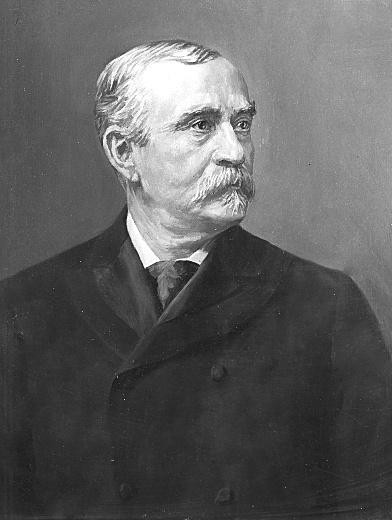
Artist: Robert Wadsworth Grafton (1876–1936)
Julius Sterling Morton
MORTON, JULIUS STERLING (1832–1902), inducted by 1920
Born in Adams, New York, and raised in Monroe, Michigan, Julius Sterling Morton received his Bachelor of Arts degree from Union College in Schenectady, New York, then staked a land claim in Nebraska Territory in 1854. There, he entered the family trade of newspaper publishing by founding the Nebraska City News. Simultaneously, Morton entered politics as a conservative Democrat, first as a territorial legislator, then as territorial secretary, and later as acting governor of Nebraska Territory. When political views shifted during the Civil War, Morton began instead to focus on forestation and agricultural initiatives on his Nebraska City farm. President of the state board of agriculture and member of the horticulture society, Morton advocated conservation programs and the planting of trees on the prairie. In 1872, the Nebraska legislature adopted Morton’s resolution to create Arbor Day. More than one million trees were planted on that first designated day, now celebrated throughout the world.
In 1893, J. Sterling Morton was appointed the US Secretary of Agriculture by President Grover Cleveland, becoming the first man west of the Missouri to serve in a Cabinet post. Morton tightened the budget while expanding the programs of the Department of Agriculture. He supported scientific studies of grasses, soils, and crop production; he looked to extend US agricultural products into foreign markets; and he improved the Weather Bureau. He was president of the American Forestry Association at that time, as well. In 1897, Morton launched a project to publish Nebraska’s history, and he founded the weekly political journal, The Conservative, but his primary legacy is as one of the nation’s early conservationists. Morton was added to the National Agricultural Hall of Fame in 1987.
Source: Saddle & Sirloin Guidebook 2026, p. 146