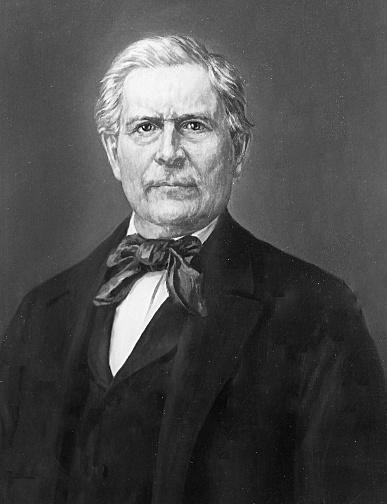
Isaac Funk
FUNK, ISAAC (1797–1865), inducted by 1920
Artist: Robert Wadsworth Grafton (1876–1936)
FUNK, MARQUIS DE LAFAYETTE (1834–1919), inducted by 1915
Artist: Robert Wadsworth Grafton (1876–1936)
FUNK, EUGENE DUNCAN SR. (1867–1944), inducted 1941
Artist: Othmar J. Hoffler (1893–1954), repainted in 1941
From pioneer beginnings, the Funk family established a prominent, multigenerational agricultural and political dynasty based at Funks Grove, Illinois. Today, Funks Grove is a National Natural Landmark and Nature Preserve.
Isaac Funk was born in Clark County, Kentucky, in 1797, but the family moved to Fayette County, Ohio, in 1800. He and his brother Absalom settled in McLean County, Illinois, in 1824 and established Funk’s Grove homestead. There, they raised corn and livestock, growing the farm to 25,000 acres. Isaac Funk was elected to the Illinois legislature in 1840 and to the state senate in 1862. He was a passionate orator supporting the Union during the Civil War. To protect their livestock interests, the Funk brothers established slaughter and retail market facilities in Chicago as early as 1839, helping to earn Isaac the nickname, “Cattle King,” but he was equally invested in hogs, sheep, and mules. His efforts preceded the founding of Union Stock Yards in 1865, the year of his death. Isaac Funk founded a professorship at Illinois Wesleyan University and left Funk’s Grove to his family.
Marquis de Lafayette Funk was named for the French nobleman who served in the Continental Army during America’s war of independence. Lafayette, as he was known, continued his father Isaac’s livestock interests and became one of the founders of Union Stock Yards in Chicago. He was elected to the Illinois legislature (1884–1888), was director of the Chicago Fat Stock Show, and served as a commissioner of the World’s Columbian Exposition. Lafayette Funk was also president of both the state Board of Agriculture and the Illinois State Fair.
Lafayette’s son, Eugene Duncan Funk, shifted the family’s agricultural focus. Initially, corn was grown on their land to support a large livestock herd, but in 1892, E. D. set aside a portion of the land to conduct research on corn families. In 1901, he formed Funk Brothers Seed Company, to produce higher yield, disease-resistant corn varieties. The company developed the first commercial corn hybrid in the world. Funk’s Tribred (1915) and Funk’s G-Series Hybrid, in the late 1930s, were key successes. E. D. Funk was president of the National Corn Association, treasurer of the Livestock Association of Illinois, and a member of the Agricultural Advisory Committee of the Food Administration during World War I.
Source: Saddle & Sirloin Guidebook 2026, p. 91