SADDLE & SIRLOIN PORTRAIT COLLECTION
HISTORICAL OVERVIEW
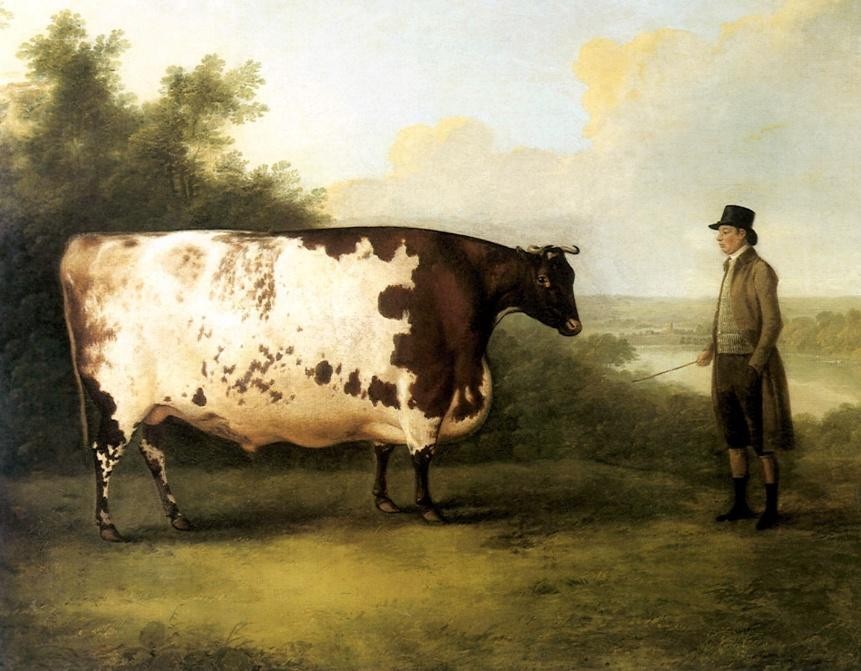
The Durham Ox was bred by CHARLES COLLING in 1796, following the breeding techniques of ROBERT BAKEWELL. The giant steer toured England in a custom carriage, thereby helping to establish the standards for the Shorthorn breed.
THE FOUNDATIONS OF THE AMERICAN LIVESTOCK INDUSTRY
UPPER CASE LETTERING in the following overview indicates individuals inducted into the Saddle & Sirloin Portrait Gallery.
Livestock were among the most valuable possessions of early Americans in the British colonies and in the newly formed United States of America two and one-half centuries ago. Cattle, swine, sheep, and horses provided food, fiber, labor, and transportation. America’s foundation stock was imported from Great Britain, where landowners such as ROBERT BAKEWELL, “CAPTAIN” ROBERT BARCLAY, and BEN TOMKINS began to selectively breed and record livestock in the eighteenth century. US Speaker of the House and envoy to Britain, Henry Clay, brought the nation’s first Hereford cattle to his Lexington, Kentucky, farm in 1817. CAPTAIN JAMES N. BROWN, FELIX RENICK, ROBERT A. ALEXANDER, and others accomplished similar milestones for other breeds, and soon American herd books and records associations were founded.
Cattle auctions on county court days inspired the first American agricultural fair, held in Massachusetts in 1811. The first fair and stock show in Kentucky—on Lewis Sanders’s Fayette County farm, followed soon after, in 1816. As county, regional, and state fairs were established across the young nation, the goals of showing, judging, and selling livestock remained primary.
Centrally located livestock pens and slaughterhouses were established to provide fresh meat for the citizens of each regional community in the growing American republic. By the 1830s, two major inland ports, Louisville and Cincinnati, were in competition to become the nation’s principal meatpacking center, exporting processed meat to Pittsburgh, New Orleans, and other major cities via the Ohio and Mississippi Rivers.
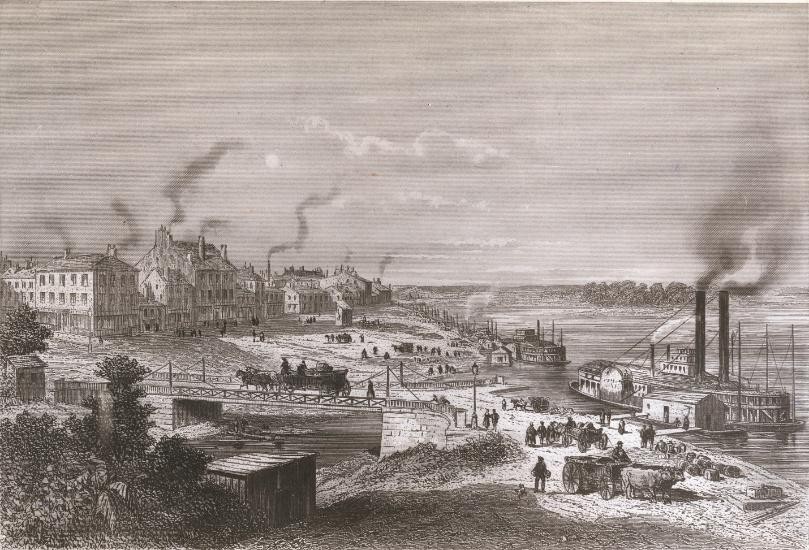
Several early livestock fairs were organized in Louisville, KY, a river city that was a commercial center during the steamboat age.
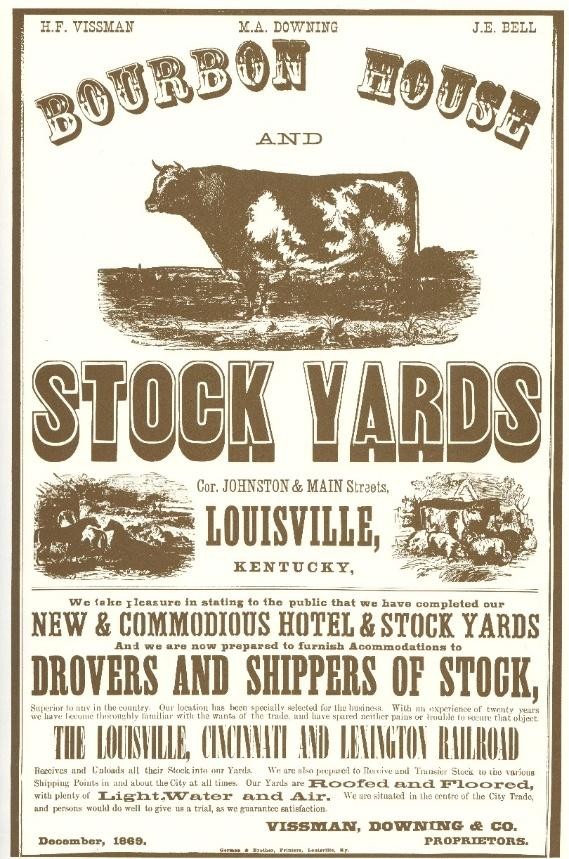
This 1869 broadside advertising the hotel at the Bourbon Stock Yards in Louisville notes the regular shipment of livestock by railroad. The Louisville, Cincinnati & Lexington Railroad opened with 175 miles of track that year.
Packing operations in Louisville’s Butchertown neighborhood continued to expand when the Bourbon House—later the Bourbon Stock Yards—opened in 1834, a business eventually distinguished as the oldest continuously operating stockyards in the United States. Rail transportation blossomed in the 1850s, expanding from 9,000 to 30,000 miles of track in that decade; and the burgeoning railroads promised the fastest possible transportation of livestock and processed meat. The local packing industry continued to grow during the Civil War, as Louisville packers earned major contracts to supply meat to the troops.
When wartime blockades all but stopped commerce along the Mississippi River—and President Lincoln signed legislation to advance the railways westward, thereby connecting western cattle ranchers to eastern markets—centrally-located Chicago quickly emerged as the hub of the nation’s new transportation industry. Soon thereafter, Chicago also became the livestock capital of the United States. Louisville’s status shifted from a national to a regional packing center, with Chicago-based companies (Swift and Armour) establishing plants in the River City, alongside local, family-operated businesses such as Fischer.
CHICAGO: CROSSROADS OF THE NATION AND
“SLAUGHTERHOUSE TO THE WORLD”
Chicago was firmly established as the transportation crossroads of the nation in 1865, when an ambitious manager of two small railroad livestock operations, JOHN B. SHERMAN, envisioned consolidating all the city’s small stockyards into one common market. Sherman organized a consortium of nine railroad companies to form the Union Stock Yard and Transit Company, and he rallied investors to convert a tract of Chicago swampland into the new center of the American meat packing industry.
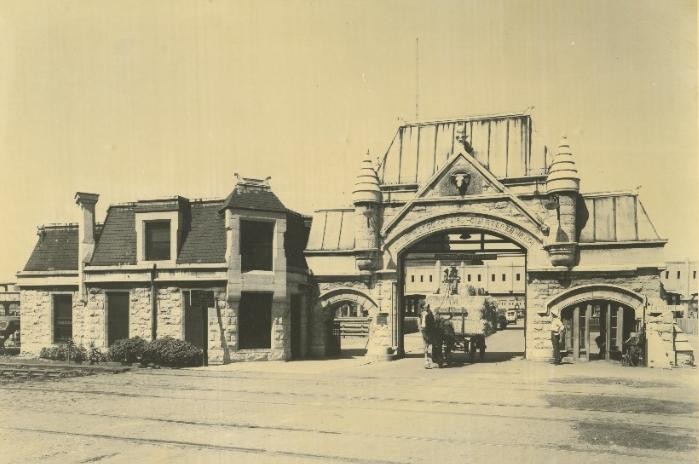
A limestone gate—an early project of famed architects Burnham & Root—marked the entrance to the Union Stock Yards. Now on the National Historic Register, the gate is one of only two Union Stock Yards structures still standing.
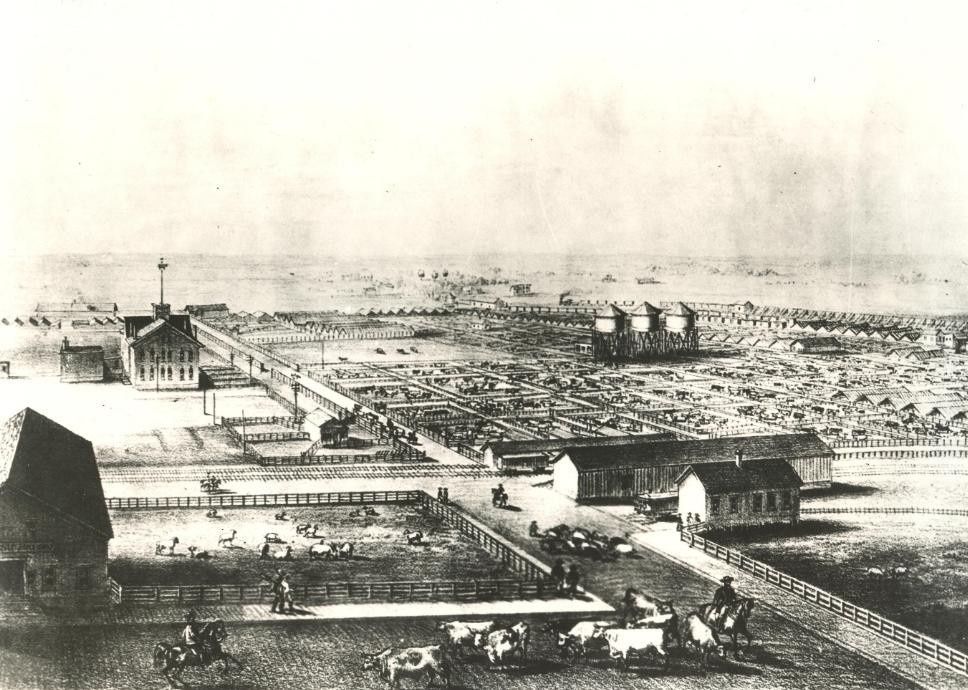
One of the earliest images of the Union Stock Yards, dating to 1866, shows the expansive site which eventually grew to occupy 475 acres.
By 1900, Chicago’s “Packingtown” employed 25,000 workers who produced 82 percent of all domestic meat consumed in the United States. This city-within-a-city was home to dozens of packinghouses and by-product factories, as well as financial, social, and residential resources to support them. Entrepreneurial men such as PHILIP DANFORTH ARMOUR SR., GUSTAVUS SWIFT SR., NELSON MORRIS, and GEORGE HAMMOND led the way.
The livestock industry headquartered at Union Stock Yards helped establish Chicago’s early identity, but it also dramatically transformed American commerce. The division of labor and the specialized meat processing stations that developed at Packingtown became a primary model for the assembly line, eventually impacting the automobile industry and all mass production. The transactions of “The Yard” influenced the development of the commodities exchange and futures market as well. Boosted by the completion of the transcontinental railroad in 1869 and the introduction of early refrigeration soon thereafter, Union Stock Yards gave rise to some of the first truly global corporations in the United States. Social reformers (including REV. MAURICE DORNEY) and labor unions fought for safety standards for the workforce, and legislators such as HENRY CULLEN ADAMS passed the Meat Inspection Act and Pure Food and Drug Act to protect consumers.
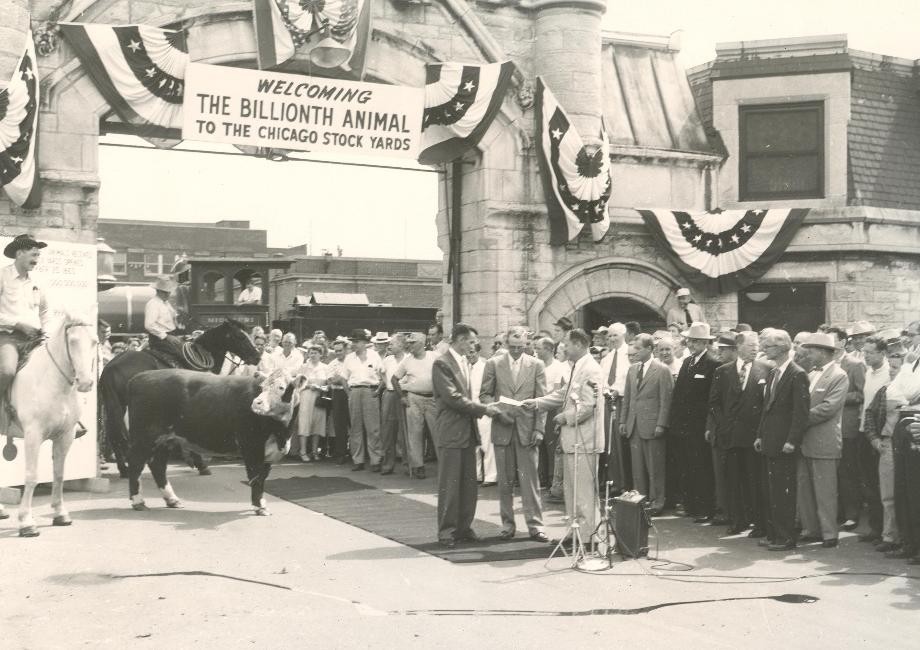
In 1954, Union Stock Yards celebrated a remarkable milestone: the sale of
the Yard’s one billionth animal.
THE INTERNATIONAL LIVE STOCK EXPOSITION:
“THE LARGEST EXHIBITION OF ITS KIND IN THE WORLD”
In 1878, with the support of the Illinois State Board of Agriculture, LAFAYETTE FUNK and COLONEL JAMES W. JUDY started the Chicago Fat Stock Show. This annual autumn market animal event emulated the historic Smithfield Club Cattle Show in London, England. The Fat Stock Show’s exposition building was demolished after the 1892 show, to make way for the World’s Columbian Exposition fairgrounds, and the Chicago Fat Stock Show ended.
Six years later, ROBERT B. OGILVIE, MORTIMER LEVERING, WILLIAM E. SKINNER, and DR. G. HOWARD DAVISON crafted a plan to bring a major stock show back to Chicago. Under the leadership of Union Stock Yards manager ARTHUR G. LEONARD and Union Stock Yards president JOHN A. SPOOR, the first International Live Stock Exposition (ILSE) opened in 1900, funded through the sale of lifetime subscriptions.
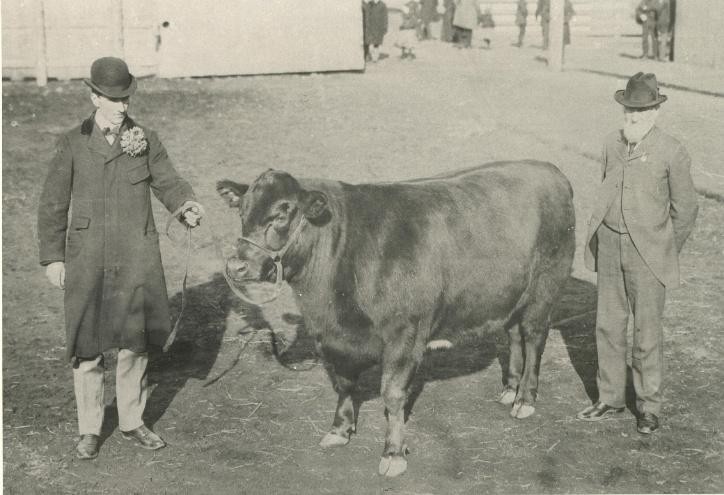
“Advance,” Grand Champion steer at the first International Live Stock Exposition in 1900, was an Aberdeen Angus owned by Stanley R. Pierce.
The first International attracted 300,000 visitors, to view more than 6,000 head of livestock. In time, the International established divisions for beef and dairy cattle, sheep, swine, draft and Saddlebred horses, grain and hay, and wool. Popular among the many educational displays was the “Meat Shoppe,” where consumers could learn about meat cuts, cooking techniques, and livestock by-products. The International was a training ground for thousands of young people each year, participating in collegiate judging and boys and girls club activities, including 4-H livestock judging.
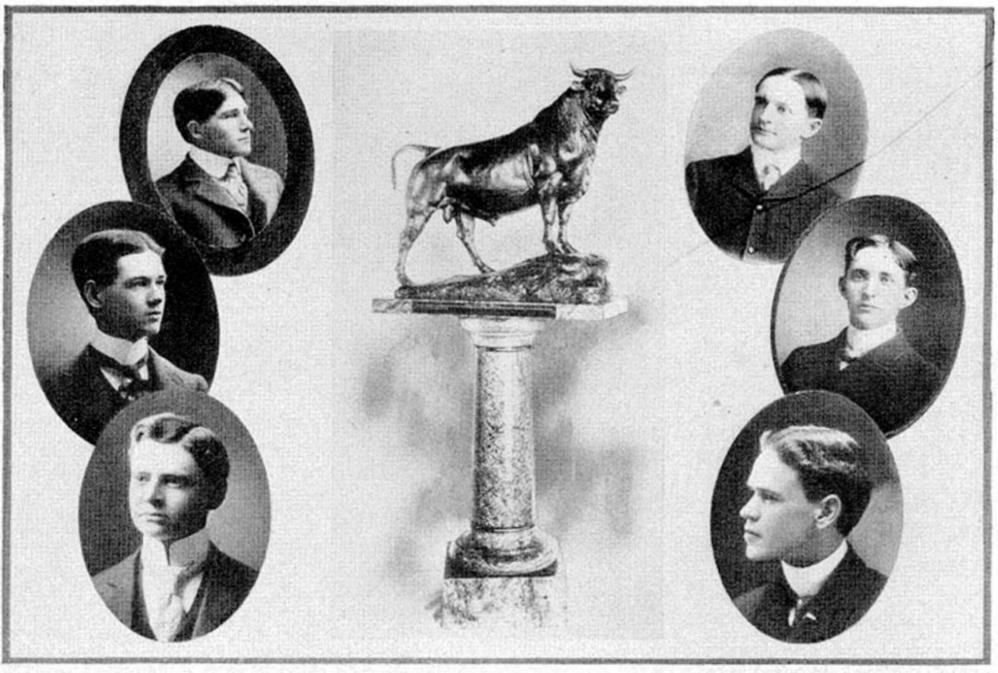
This team from the University of Illinois won the first National Collegiate Livestock Judging Contest in 1900. Winning teams received the Spoor Trophy featuring a likeness of a bull sculpted by French artist Isidore Bonheur. The image of the “defiant bull” has served as the emblem of both the International and the Saddle & Sirloin portrait collection.
The continued success of the show through the First World War and the Great Depression demonstrated the importance of the livestock industry. During its run from 1900–1975, the International was cancelled for only two reasons, the devastating foot-and-mouth epizootic of 1914–1915 and the Second World War. It remained one of the premier livestock events in the nation for decades.
Ironically, transportation trends—responsible for the founding of Union Stock Yards—also contributed to the demise of the ILSE. The development of the federal highway system and refrigerated trucking allowed meatpackers to move their operations to less costly rural communities, away from the railroad centers. With this decentralization, Union Stock Yards closed in 1971, and the last International Live Stock Exposition was held there in 1975.
A FITTING SUCCESSOR TO THE INTERNATIONAL:
THE NORTH AMERICAN INTERNATIONAL LIVESTOCK EXPOSITION
Just as the final chapter for the International Live Stock Exposition was closing, a new showcase for the industry was making history. The first North American Livestock Exposition (NALE) was held in 1974, at the Kentucky Fair & Exposition Center in Louisville. The show had its origins in two previous Louisville shows, the Bourbon Beef Show, founded in 1946, and the Louisville Fat Cattle Show which preceded it, 1922–1946.
The Louisville Fat Cattle Show was a cooperative project of the Bourbon Stock Yards Company, the Live Stock Exchange, and the University of Kentucky College of Agriculture, to “stimulate the interest of farm youth and adults in the production of the finest quality beef cattle.” Entries grew from 250 in the inaugural year of 1922 to over 1,500 in 1937. After the Fat Cattle Show’s silver anniversary in 1946, the show ended, and its youth events transitioned into the 4-H and FFA cattle show at the Kentucky State Fair. Also in 1946, the Bourbon Beef Show was established with both youth and open events. By 1960, it was one of the largest shows of its kind in the nation, outgrowing the facilities at Bourbon Stock Yards. The show moved to the Kentucky Fair & Exposition Center for two years but closed when the Kentucky Distillers Association was unable to continue their sponsorship of the event. The short-lived Louisville Steer and Carcass Show then tried to take hold at Bourbon Stock Yards in the early 1970s. These shows served as predecessors to the North American.
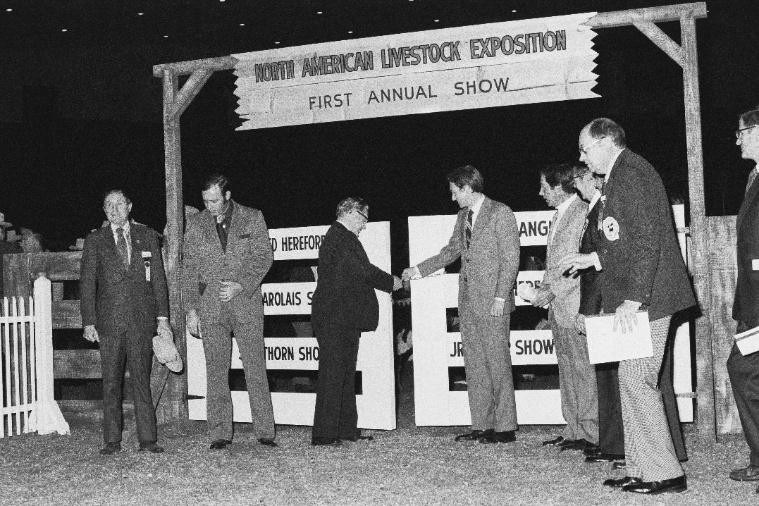
Officials open the gates for the first North American Livestock Exposition in 1974.
The first NALE was a beef show, but from its inception, plans were in place to expand to other species. After adding shows for sheep, dairy, swine, and quarter horses, the NALE was renamed the North American International Livestock Exposition (NAILE) in 1978, directly acknowledging the ties to the legacy of Chicago’s International. However, early NAILE leaders, including HAROLD WORKMAN, JACK RAGSDALE, Garland Bastin, and CHARLES BARNHART, envisioned a different kind of livestock show—one focused on the exhibitor’s interests and needs, with ever-expanding opportunities for youth to compete, both in the ring and in academic contests. The North American became the new home for the National Collegiate and National 4-H Livestock Judging Competitions, and as the show grew, BOB HALL created additional opportunities for youth to earn coveted premiums. The NAILE Steer Show and Market Lamb Show became junior events in 1979, and the first Supreme Drive was added to the Junior Heifer Show in 2007. NAILE species continued to expand as well, as draft horses, dairy goats, llamas, alpacas, Boer goats, mules, and donkeys arrived to compete on the legendary green shavings.
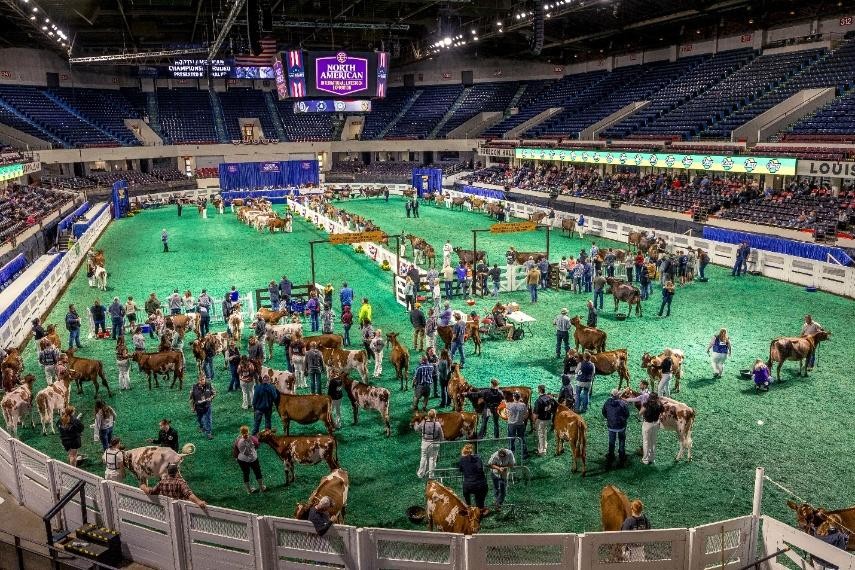
Today, the North American International Livestock Exposition is the world’s largest purebred livestock show. The 50th Anniversary of the NAILE was celebrated in 2023 with a historical display, commemorative video, and oral history video project documenting memories of the show’s founders and leaders.
A PORTRAIT GALLERY TO HONOR THE GREATS OF THE LIVESTOCK INDUSTRY
In 1903, two founders of Chicago’s International Live Stock Exposition—ROBERT OGILVIE and ARTHUR G. LEONARD—along with livestock journalist and historian ALVIN H. SANDERS, envisioned a well-appointed space to meet and entertain visitors and business associates at the Union Stock Yards. The top floor of the Pure Bred Live Stock Record Building—home to various national breed registry associations—was designated for this purpose. The impressive Tudor- and Mission-style reception and banquet rooms of the “Saddle & Sirloin Club” were places where livestock men could gather over a sirloin or a saddle of lamb.
The Saddle & Sirloin Club founders decided that their retreat should house a painted portrait collection, paying tribute to individuals who had made significant contributions to the advancement of animal husbandry. The Club quickly evolved into, as Sanders described in his 1915 published history of the origins of the Club, “a Pantheon” dedicated to honoring the great leaders of the livestock industry and inspiring “all who seek to follow in their footsteps.”
The first portrait hung in the Club was of WILLIAM ARNON HENRY, the first Dean of the College of Agriculture at the University of Wisconsin. Ogilvie commissioned Wisconsin portrait painter, James R. Stuart, to create Dean Henry’s likeness, along with portraits of eighteenth- and nineteenth-century foundational breeders from the British Isles, including brothers CHARLES and ROBERT COLLING, THOMAS BOOTH, and WILLIAM WETHERELL. Impressed with these initial installations, HENRY F. BROWN, a Shorthorn breeder and timber and iron ore baron, commissioned Stuart to paint several more portraits for the Club, mostly depicting “great men of the olden days.”
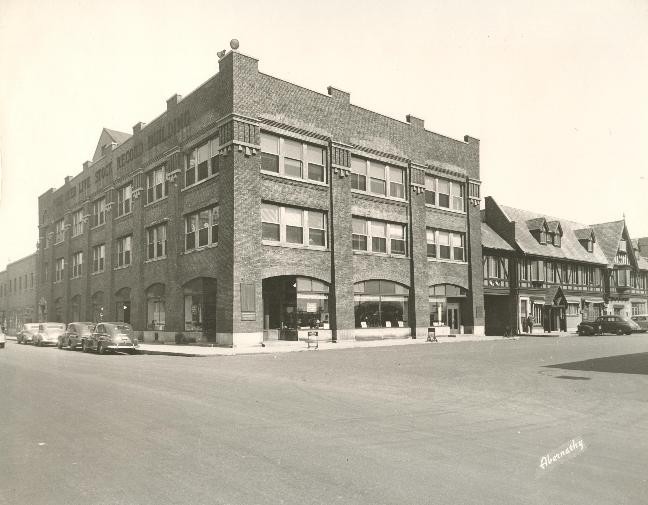
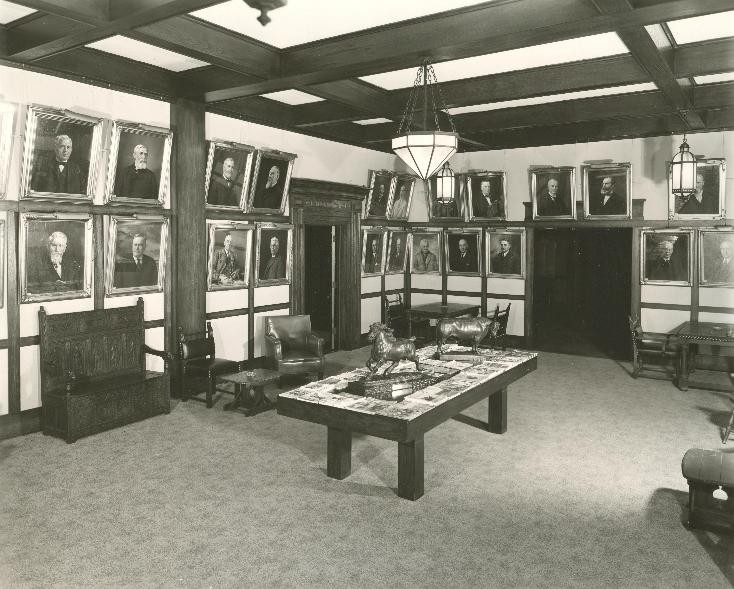
The Saddle & Sirloin Club was in the Pure Bred Live Stock Record Building, adjacent to the Stock Yards Inn.
The Club selected some of the finest portrait artists working in America to follow Stuart as its official painters, including ARVID NYHOLM and ROBERT W. GRAFTON, whose years of service to the Club overlap. These two painters were so significant to the collection that self-portraits of each were added to the Saddle & Sirloin gallery.
Once the foundational breeders were honored, the Club began to focus on more contemporary industry figures. A formal process of nomination and review by a selection committee developed, with honorees usually inducted at a formal dinner held during the International. When Armour & Company executive and ILSE ringmaster, EDWARD WENTWORTH, himself an avid art collector, published the first catalogue of Saddle & Sirloin biographies in 1920, he documented 127 inductees. The gallery continued to grow, with several portraits added annually, including a few that came into the collection other than by official nomination.
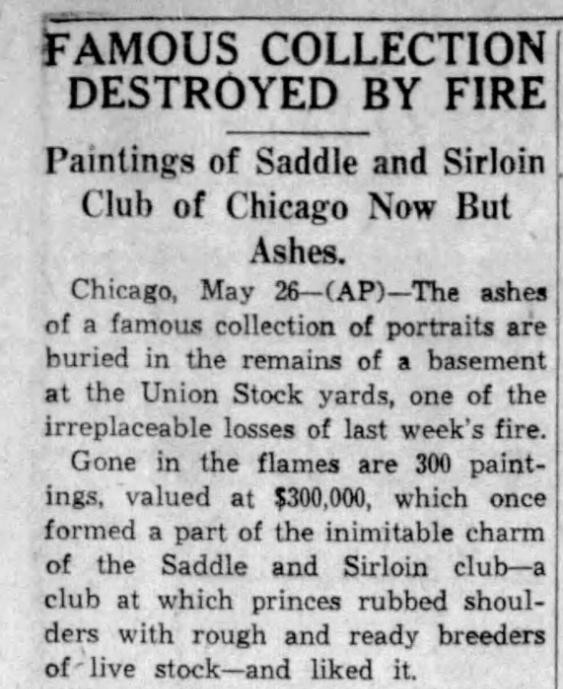
On May 19, 1934, tragedy struck at Union Stock Yards: a fire quickly spread from the wooden, hay-filled livestock pens to surrounding buildings, engulfing nearly all the main buildings that housed the International Live Stock Exposition. The more than 200 portrait paintings, as well as the records documenting the first three decades of Saddle & Sirloin inductees, were destroyed. A newspaper reported that 300 paintings were lost—the entire portrait gallery and a sizeable number of animal and landscape paintings. Only a bronze sculpture of the Greek god of herdsmen, Hermes, and a few bronze plaques survived the blaze, and they remain with the collection today.
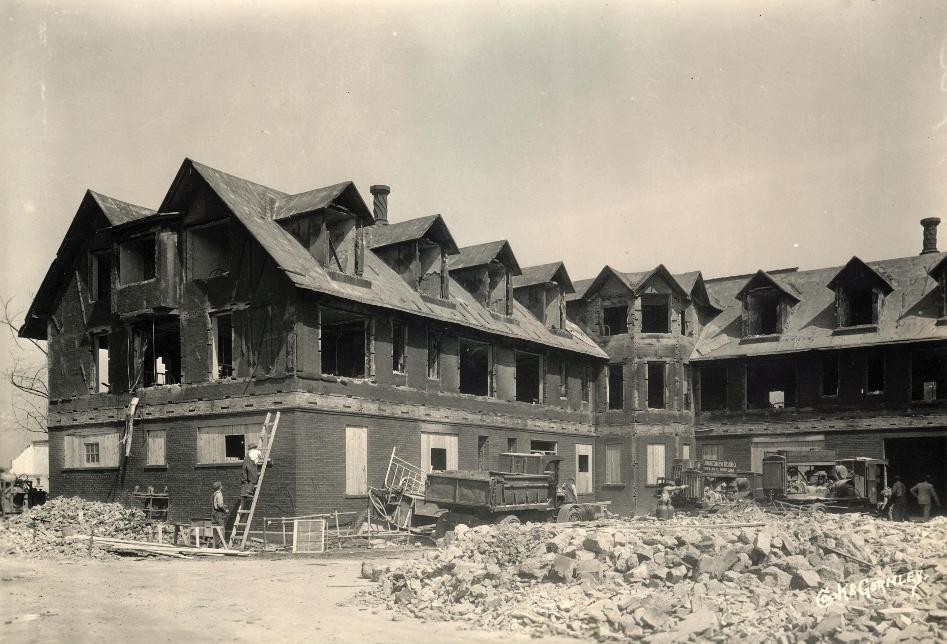
The fire that destroyed the Saddle & Sirloin portrait gallery was not as tragic as the historic 1910 Union Stock Yards fire which killed twenty-one firefighters and three Yards workers, but one cowboy and several hundred head of livestock did lose their lives in the 1934 blaze. Eight square blocks within the complex were destroyed, including the Stock Yard Inn (pictured here) and the adjacent Pure Bred Live Stock Record Building.
After the fire, the facilities were quickly rebuilt, with financial support from Union Stock Yards chairman FREDERICK H. PRINCE. Robert Grafton began the daunting task of repainting the Saddle & Sirloin portraits. By the time of his death in December 1936—in a mere two-and-one-half years—Grafton had painted an astonishing 164 portraits for the collection. Almost all of these were replacements for the ones lost. Grafton based many of the replacements on photos of the original portraits, and of course, he had painted a few of the originals initially.
With Grafton busy repainting so many portraits, Othmar Hoffler stepped in as one of the new artists of record for new honorees, just a few months before Grafton’s death. Hoffler may have also painted some of the replacements, as not all induction dates are presently known. (As additional newspapers and publications are digitized around the country each year, our research to update the guidebook frequently uncovers new details, including induction dates.) Artist Ernest Klempner was also working at this time on both post-fire replacements and new induction portraits.
Seven portraits painted prior to 1934, which presumably were not a part of the collection at the time of the fire, are now the oldest works in the gallery. The oldest of these seven is a rather small portrait by the prolific English artist Thomas Weaver. In 1811, Weaver painted the celebrated British livestock promoter JOHN DAY, perhaps from life. It is likely that someone donated the painting to the collection sometime after the fire.
The undated portrait of President ULYSSES S. GRANT is by Oliver Ingraham Lay, who died in 1890, so this painting also predates the Saddle & Sirloin Club itself. Grant is one of five American presidents recorded in the 1920 published guide to the collection, and the only one of that group to still be represented in the gallery after the fire. The destroyed portraits of Presidents Washington, Jefferson, Lincoln, and Franklin D. Roosevelt were never replaced. According to a plate affixed to the back of the frame, President Grant’s portrait was presented to a veterans’ fraternal organization in New York in 1911. Presumably, a different portrait of Grant perished in the fire, and the work by Lay was brought in to take its place. (Five other subjects from American history—the only other honorees not directly related to agricultural interests—were also lost in the fire and were not replaced in the collection: early statesmen Benjamin Franklin, Alexander Hamilton, William Penn, and Daniel Webster, and US Supreme Court Chief Justice John Marshall.)
The 1904 portrait of The Breeder’s Gazette founder JAMES HARVEY SANDERS and the 1908 portrait of packing company giant NELSON MORRIS are very special to the collection, as they were painted by the first Saddle & Sirloin artist, James R. Stuart. Alvin Sanders provided the Club with the 1904 Sanders portrait, as well as a portrait of himself, to replace those lost in the fire. Both had been hung in Sanders family residences. The Stuart portrait of Morris was not the official induction portrait, for a different portrait of Morris (the one without a hat) is pictured in the 1920 catalogue of the collection. There are two portraits of Morris in the collection today: the one by Stuart and the post-fire replacement by Robert Grafton, similar to the original induction version (sans hat). Interestingly, the first published list of portraits in the collection, dated 1948, indicates that there were two paintings of Morris then as well, one hanging in the Library and one in the Banquet Hall.
Correspondence from Arthur Leonard indicates that the Nelson Morris portrait was one of the first prioritized for replacement by Grafton, along with the one of Morris’s son, EDWARD, and portraits of P. D. and J. O. ARMOUR, GUSTAVUS SWIFT, THOMAS WILSON, JOHN B. SHERMAN, EDSON WHITE, ROBERT OGILVIE, G. HOWARD DAVISON, and JOHN CLAY JR. Leonard also indicated that Grafton would complete the portraits of college deans and those of the early breeders with particular urgency. The latter were hung in a special, shrine-like room known as the “Sanctum Sanctorum”—literally, the “Holy of Holies.”
The 1913 portrait of rancher WALTER FARWELL, by the Russian painter Ossip Perelma, predates the fire as well. Perelma’s only contribution to the Saddle & Sirloin was not commissioned for the collection but was, instead, added to the gallery some years after it was painted. Finally, the only other works that predate the 1934 fire are both by Arvid Nyholm, the collection’s second official artist who died in 1927: the undated portrait of Saddle & Sirloin co-founder Alvin Sanders (mentioned above) and a self-portrait of Nyholm, dated to 1922. The self-portrait was added to the collection by 1945, for the Saddle & Sirloin Club loaned it to the Art Institute of Chicago that year.
Reincarnated after the blaze, the Saddle & Sirloin Club continued to grow in the succeeding decades. In many years, several inductees were added annually, including honorees nominated by the American Society of Animal Production (now the American Society of Animal Science)—primarily individuals representing the research and academic aspects of the industry. In 1955, however, the Portrait Committee announced that available wall space in the Club had become limited, so it would no longer accept nominations from the Society each year.
The collection depicts livestock breeders, association officials, judges, ranchers, packing industry administrators, financiers, journalists, educators, researchers, veterinarians, auctioneers, agriculture policy makers, politicians, and others. By the closing of the International in 1975, Club recordkeepers had catalogued at least 333 portraits. Some twenty-five portraits mentioned in the records are no longer a part of the collection, including works that were not repainted after the fire or did not move with the collection to Louisville.
Before the Saddle & Sirloin Club was razed in Chicago, its members considered proposals from a dozen institutions interested in maintaining the traditions and the perpetual care of the Portrait Collection. In 1976, Club members selected the Kentucky Fair & Exposition Center (now known as the Kentucky Exposition Center) as the new home for the collection. The portraits—just over 300 of them—were moved to Louisville in 1977, and with them, the legacy of the International was transferred to the North American International Livestock Exposition (NAILE). The care of the collection was transferred to the Kentucky State Fair Board, a state agency in the Kentucky Tourism, Arts, and Heritage Cabinet.
Today, the traditions continue of the collection now known as the Saddle & Sirloin Portrait Gallery, the Livestock Industry Hall of Fame, with new members inducted during the NAILE. In 1978, the first inductee was added in Louisville, after a three-year hiatus. Two portraits joined the gallery in 1987, but since that time, only one new individual has been honored each year. The 50th portrait inducted in Louisville will join the gallery in November 2026.
The Kentucky State Fair Board, which manages the livestock expo and the Kentucky Exposition Center, continues its work to care for, display, and research the collection. A research and editing project was completed in 2013, to expand and update the background information and the inductees’ biographies. Including the portrait added in November 2026, the total number of individuals believed to have been honored throughout the Saddle & Sirloin’s 122-year history now stands at 383, with 370 portraits still physically represented in the collection (twelve of these are duplicates of works temporary lost while in storage at the Executive West Hotel in the 1980s but later recovered). Ongoing research leads to newly digitized newspaper clippings and archival documents related to induction ceremonies once lost in the fire. When this happens, names and biographies are added to the gallery roster, even though the portraits are no longer a part of the collection. Dr. Walter Handschin and Abram Renick are the latest additions of this kind.
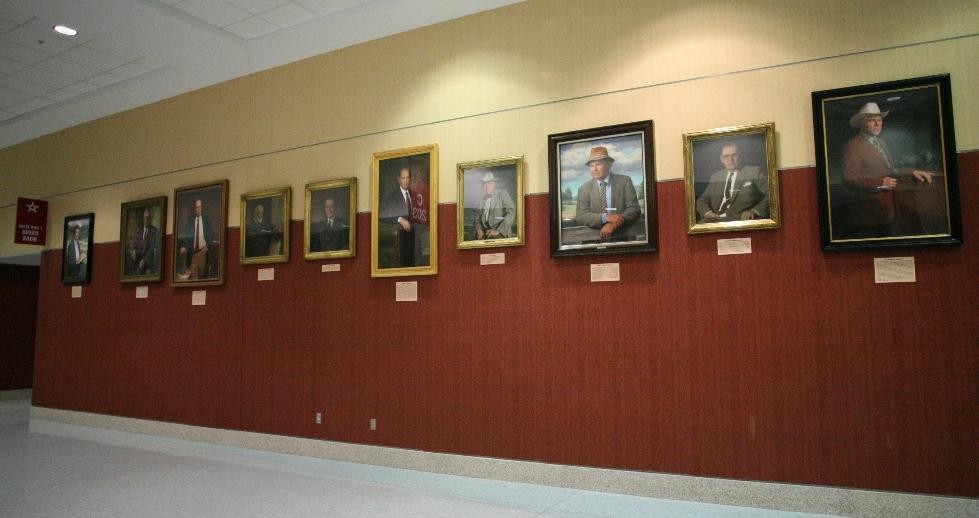
Thought to be the largest collection of painted portraits commemorating a single industry, the Saddle & Sirloin Portrait Gallery—the Livestock Industry Hall of Fame—continues the heritage of its founders, to pay homage to those who have made the greatest contributions to the livestock industry.
THE KENTUCKY EXPOSITION CENTER IN LOUISVILLE
Celebrating its 70th year in 2026, the Kentucky Exposition Center (KEC) is one of the largest public facilities in the United States, with 1.2 million square feet of indoor space, including historic Freedom Hall and Broadbent Arena. KEC is now undergoing the largest expansion and renovation in its history, a nearly half-billion-dollar, two-phase project. Phase I, a 350,000-square-foot multi-purpose building, is set for completion in December 2026. When both phases are complete, KEC will be the fifth-largest facility of its kind in the nation, with an estimated 1.5 million square feet of climate-controlled space supporting the region’s thriving agricultural and trade show sectors, including the agency’s six in-house shows and events, and the facility’s diverse client roster.
KEC is the permanent home of the National Farm Machinery Show and Championship Tractor Pull, the Kentucky State Fair, the World’s Championship Horse Show, and the North American International Livestock Exposition and North American Championship Rodeo. The Saddle & Sirloin Portrait Gallery is displayed on the South Wing Conference Center mezzanine and in the Freedom Hall VIP Suite, known as the Saddle & Sirloin Club.
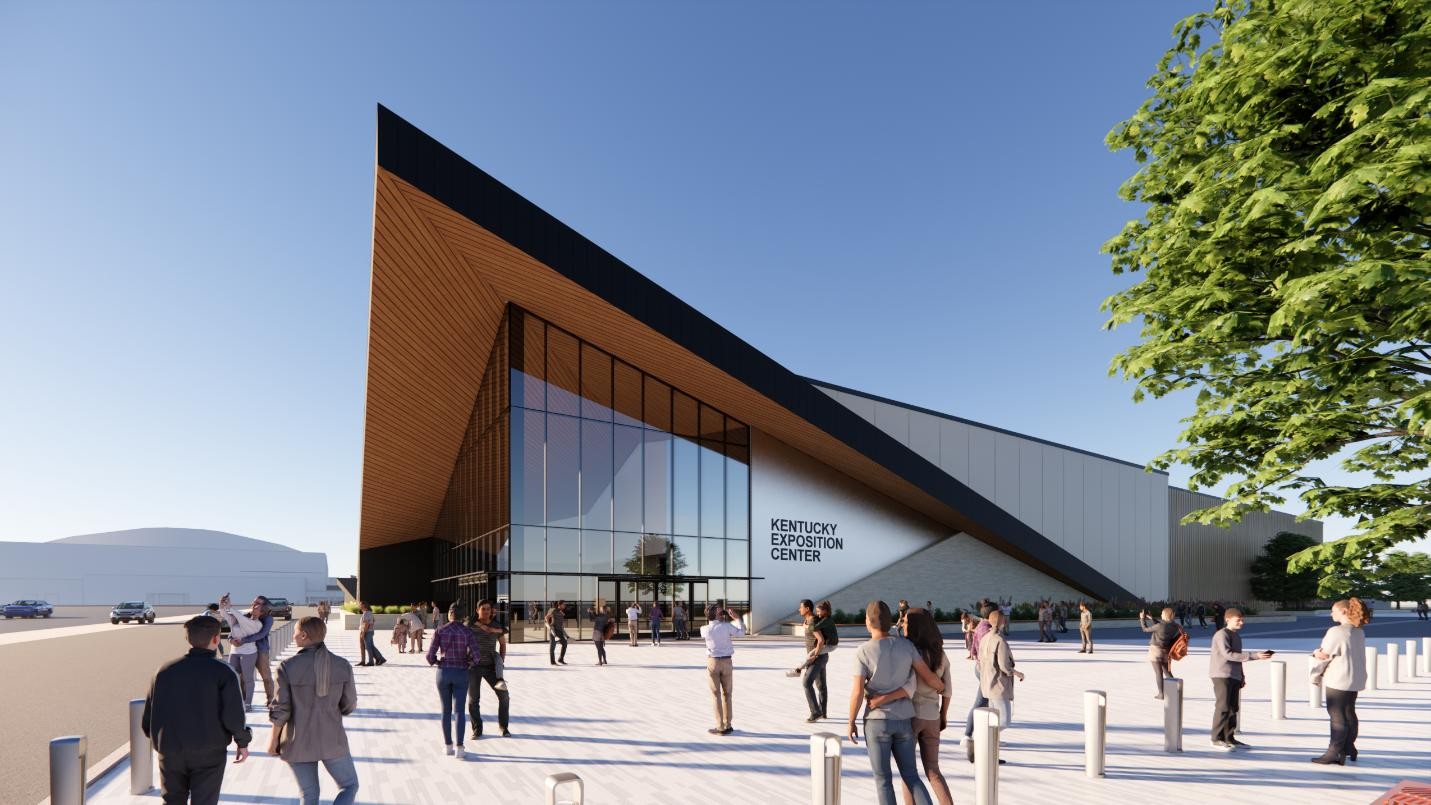
Architectural rendering of the Phase I multi-purpose building anticipated to be completed in December 2026.