THE ARTISTS OF THE SADDLE & SIRLOIN PORTRAIT GALLERY
Many of the nation’s finest portraitists have been commissioned to create Saddle & Sirloin portraits. Unfortunately, the artist names are not recorded for a small number of the paintings, so this list of artists may not be complete. We welcome any additional information to strengthen the collection files.
The following artist biographies are listed in chronological order, according to when the artists added portraits to the collection.
James Reeve Stuart (1834–1915)
James R. Stuart was the painter of the original portraits that formed the nucleus of the Saddle & Sirloin portrait collection. Robert Burns Ogilvie and Henry F. Brown commissioned Stuart to paint more than a dozen paintings of foundational livestock breeders for a room in the Club that would be called the Sanctum Sanctorum, the “Holy of Holies,” the innermost shrine. The works that launched the collection in 1903 were lost in the 1934 fire, however two portraits by Stuart are still in the collection, James Harvey Sanders and one of the two Nelson Morris likenesses. The Stuart version is the one that shows meat packing giant Morris wearing a hat.
Born in Beaufort, South Carolina, to wealthy plantation owners, Stuart attended the College of South Carolina, University of Virginia, and Harvard College, and he studied in the Boston art studio of Joseph Ames. He was the second American accepted to study at the Royal Academy in Munich, Germany, and he also studied at the Karlsruhe Art School. When the Civil War began, Stuart returned home to join the Confederate Army. He continued to paint, and Generals Leonidas Polk and “Stonewall” Jackson were among his subjects. His family’s estates decimated by the war, Stuart relocated to Savannah, Georgia, and established an art studio. In 1867, he moved his studio to St. Louis and began to travel for portrait commissions. After visiting Madison, Wisconsin, for a commission in 1872, he decided to move there permanently. Stuart served as Artist-in-Residence at the University of Wisconsin and taught at Milwaukee College. In addition, he was a founding member of the Studio Club.
James R. Stuart’s paintings may be found in the Madison Capitol Building and the Museum of Fine Arts Boston, but the largest public collection of his work (at least thirty-two paintings) is now in the Wisconsin Historical Society, where he once served as curator. Interestingly, this Wisconsin collection includes four Stuart portraits of men who were also inducted in the Saddle & Sirloin Club. Two of those portraits, dated 1891 and 1906, are of William D. Hoard; one is an 1888 portrait of Jeremiah Rusk; and the fourth is a 1913 likeness of William Freeman Vilas. Arvid Nyholm painted the original Saddle & Sirloin portrait of Hoard, and likely, of Rusk, too; but the artist of the original induction portrait of Vilas is not recorded.
Oliver Ingraham Lay (1845–1890)
There are a few portraits in the collection that are singular works by well-known artists. Some of the artists were chosen specifically to paint a particular honoree’s likeness, but for others, their presence in the gallery is a mystery. The portrait of President Ulysses S. Grant is one such mystery, although a few clues are available. This painting by Oliver Ingraham Lay was presented to the Ulysses S. Grant Post No. 327 of the GAR (Grand Army of the Republic, a fraternal organization of Civil War veterans), Brooklyn, New York, by Charles A. Manson in 1911, according to a metal plate affixed to the back of the frame. The work is undated, but artist Oliver Ingraham Lay died in 1890. Where it was prior to 1911 is part of the mystery, as is how or when it came to Chicago to join the Saddle & Sirloin. We do know that a portrait of Grant was in the collection by 1920, perhaps painted by Arvid Nyholm or Robert Grafton, but it was lost in the 1934 fire. The Lay portrait was presumably purchased or donated to the collection after the Club was rebuilt.
Oliver Ingraham Lay was born in New York City, where he studied at Cooper Union, the National Academy of Design, and Thomas Hicks’s studio. He was a regular exhibitor at the Century Association, an arts and letters club founded by editor and poet William Cullen Bryant. Many leading artists in New York were among its members, including Winslow Homer, who was painted by Lay. Lay also painted a portrait of his friend and mentor, Fedelia Bridges, one of the most prominent women artists of the nineteenth and early twentieth centuries. Oliver Ingraham Lay’s son, Charles Downing Lay, was one of the first landscape architects of renown in the United States.
Ossip Perelma (1876–1950)
Only one Saddle & Sirloin work (the only pastel on paper in the collection) has been attributed to this Russian nobleman and artist—the 1913 portrait of Walter Farwell—but no story remains to explain how it came to the collection after the 1934 fire. Ossip Perelma (also known by several variations of that name, including Ossip Perelman and Count Ossip de Perelma) studied painting at the Imperial Academy of Russia and lived in Paris for a time. He traveled to the United States in 1913 and again in 1916, when he applied for citizenship. (He was naturalized in 1927.) Perelma resided in various US cities over the next many decades, including Washington, DC; New York City; Riverside, California; and Sarasota, Florida.
In 1916, a New York art gallery hosted an exhibition of Perelma’s portraits, including one of Mrs. Walter Farwell, which may have been painted when Perelma was portraying her husband. The United States National Museum on the Washington Mall (one of the first Smithsonian museums) exhibited forty-eight portraits and narrative paintings by Perelma in 1917. In 1918 and 1919, one-man shows of his works were organized at the Corcoran Gallery and the Detroit Institute of Arts. During his career, Perelma painted several prominent Americans, including President Woodrow Wilson, Assistant Secretary of the Navy Franklin D. Roosevelt, Secretary of the Interior Franklin Lane, and Russian ambassador Boris Bakhmeteff.
Arvid Frederick Nyholm (1866–1927)
Born in Stockholm, Sweden, Arvid Nyholm studied architecture and theatrical painting before shifting his focus to portrait and landscape painting. He studied at the Royal Academy of Fine Arts in Stockholm, as well as privately with Anders Zorn, one of Sweden’s most prominent artists. Nyholm immigrated to New York City in 1891 and eventually settled in Chicago in 1903, where he exhibited regularly at the Art Institute and the Swedish Club. Two significant independent commissions of his career were portraits of Minnesota governor Adolph Olson Eberhart (1917) in the state’s capitol building and Swedish American inventor and engineer John Ericsonn (1927) in the National Portrait Gallery, Washington, DC.
In 1922, the University of Wisconsin-Madison established its own Agriculture Hall of Fame portrait gallery, initiated by Robert Ogilvie, one of the Saddle & Sirloin collection founders. Arvid Nyholm painted thirteen portraits for Agriculture Hall on the UW campus, and six were subjects previously inducted in Chicago (Babcock, Craig, Henry, Hoard, Russell, and Vilas). It is possible that Nyholm contributed the original, pre-fire portraits of these men to the Saddle & Sirloin as well.
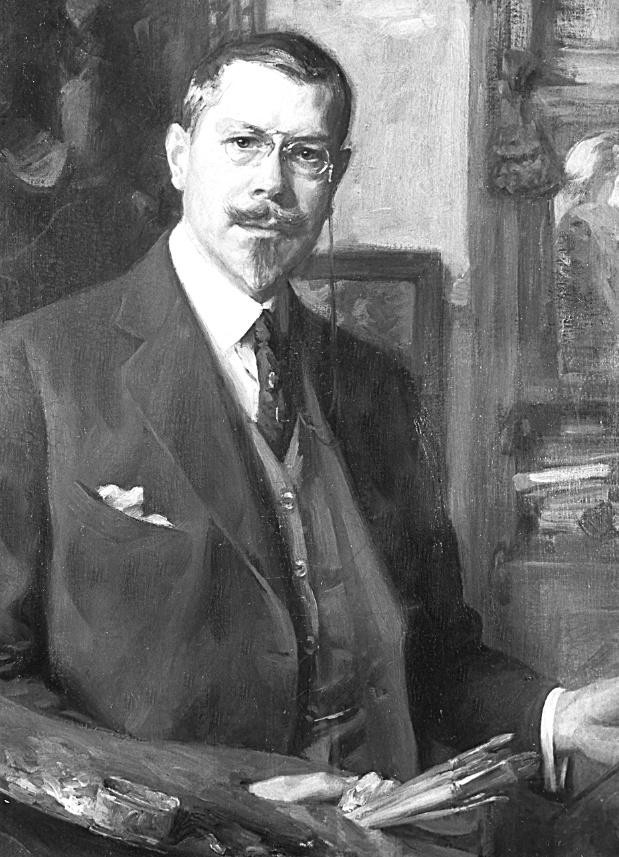
Nyholm became the second long-term Saddle & Sirloin portraitist, although few records remain to document this period of work. The dates of his employ and the total number of portraits he contributed are unknown, since records and works were lost in the fire, but two works by him are in the collection today, the portrait of Alvin Sanders and Nyholm’s own self-portrait, dated 1922. His self-portrait was likely added to the collection sometime after his death in 1927.
Robert Wadsworth Grafton (1876–1936)
More works in the Saddle & Sirloin Portrait Gallery today are by Robert Grafton than any other artist: 160. Born in Chicago in 1876, Robert Wadsworth Grafton studied at the Chicago Academy of Design and the School of the Art Institute of Chicago before traveling overseas to study at the Académie Julian in Paris, as well as in the Netherlands and England. After his return to Chicago, he became involved in several artists’ organizations, including the Palette and Chisel Club, becoming its president in 1906.
Grafton moved to Michigan City, Indiana, and spent winters painting in New Orleans between 1916 and 1920, with his friend Louis Oscar Griffin. There, the two collaborated on murals in the St. Charles Hotel in 1917. Grafton painted many other murals, too, including those for the Tippecanoe County (Indiana) Courthouse, the Illinois State Capitol, the Lafayette School in Chicago, the Hotel Rumely in La Porte, Indiana, and the First National Bank in Elkhart, Indiana. Perhaps best known for his portraits, however, Grafton depicted three Indiana governors and two US presidents, Calvin Coolidge and Herbert Hoover. These latter two were for the Saddle & Sirloin collection. Both presidents sat for the painter in the White House—a rare honor for a portrait artist—and charming stories have been recorded about those two projects.
In 1929, Union Stock Yards president Arthur G. Leonard arranged for Robert Grafton to visit the White House to paint Calvin Coolidge for the Saddle & Sirloin Club, just before Coolidge’s term was to end. Details about Grafton’s encounters with the President in 1929 were documented by the President’s Secret Service agent, Colonel Edmund W. Starling, in his 1946 best-selling memoir, Starling of the White House, and later excerpted in the 2002 anthology, Katharine Graham’s Washington. According to Agent Starling, Grafton found President Coolidge to be true to his reputation: quiet and hard to read. The artist felt that he might be unable to complete the commission because the President would not reveal anything about himself. One day, the nervous painter knocked over a can of turpentine on a White House rug, but a twinkle came into the President’s eyes as he said, “Now don’t you worry about the old rug. I’m going to move out of here in a few days.” The exchange enabled Grafton to establish a warm rapport with the President and finally capture the true spirit of the man on the canvas. Agent Starling admired the finished painting, saying, “He captured the little fellow exactly—half owl, half elf.”
Four years later, Herbert Hoover’s Secretary of Agriculture, Arthur Hyde, arranged for Grafton’s White House sittings with the 31st President. (Grafton had painted Secretary Hyde’s portrait for the Club the year before, so the two men were well acquainted.) A newspaper reported that the sittings were constantly interrupted by meetings, and President Hoover even signed some legislation while Grafton was painting him. After spending as much time in the White House as the President would allow, Hoover sent Grafton back to his studio in Michigan City with the suit he had been wearing for the sittings. Grafton arranged for a model to pose in the President’s clothes, so the work could be completed.
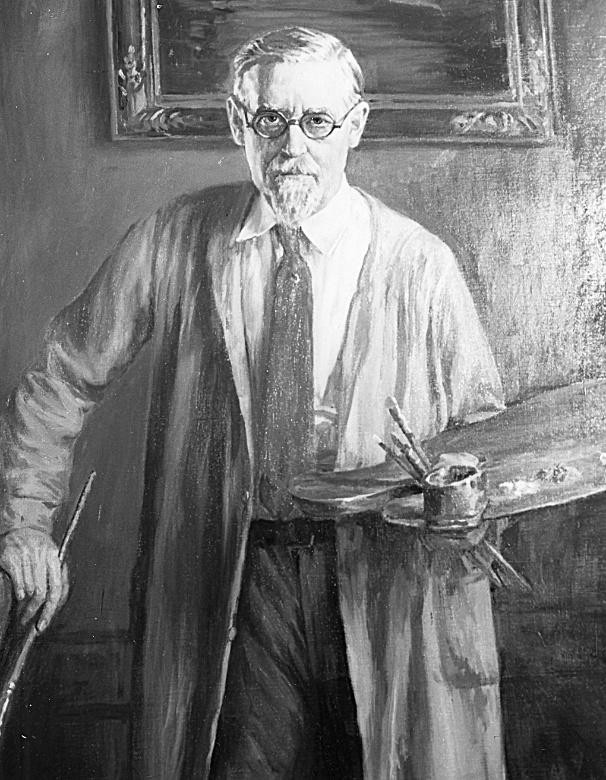
Robert Grafton became an official Saddle & Sirloin Club portraitist around 1915 and then was later commissioned to repaint the portraits destroyed by the 1934 fire. For the last two years of his life, Robert Grafton painted with tremendous speed, returning 162 of the lost portraits to Chicago, and painting two new inductees during the same period. (Four of these works are no longer in the collection.) His signature is visible on only one, the likeness of Frederick Pabst Sr. His own portrait, a self-portrait, was hung in the collection to honor his extraordinary accomplishment and contribution. The Chicago Daily Tribune reported that the re-painting project contributed to Robert Grafton’s early death in 1936, at age 59.
Othmar J. Hoffler (1893–1954)
Stepping in after Grafton’s death was Othmar Hoffler, who painted seventy-seven Saddle & Sirloin portraits from the mid-1930s through the early 1950s, an average of four or five per year. Four of those were post-fire replacements. Seventy-four Hofflers remain in the collection today. Born in Buffalo, New York, where he attended the Art School of the Buffalo Fine Arts Academy, Hoffler had settled in Chicago by 1930. He was active at the School of the Art Institute of Chicago and in the Palette and Chisel Club, earning the club’s Gold Medal in 1930 and serving as an officer in 1935. Most of his documented works are portraits, including five presidents of Iowa State University.
Benjamin Soloman Kanne (1897–1952)
Benjamin Kanne was a Russian artist who, like many others, moved to Chicago to work. He painted four portraits in the collection during the second quarter of the twentieth century.
Ruth Alice Anderson (Temple) (1891–1957)
Born in Pennsylvania, Ruth A. Anderson worked as a painter in Baltimore and Boston, spending summers in Gloucester, Massachusetts. Her married name was Temple, although she did not use it professionally. Anderson initially studied art with her aunt, Esther M. Groome, a painter who worked in the Impressionist style. She also studied at the Pennsylvania Academy of Fine Art under Cecilia Beaux and William Merritt Chase, among others. Her work was exhibited widely, including at the Pennsylvania Academy, the Art Institute of Chicago, and the Corcoran Gallery. Given that many of her works were destroyed in a 1930s art studio fire, Anderson’s portrait of John Spoor is particularly valuable today. The artist’s career was impacted by vision loss during the final seven years of her life.
Oskar Gross (1871–1963)
Born in Vienna, Austria, the son of a prominent architect, Oskar Gross graduated with honors from the Imperial Academy of Fine Arts in 1896. Before graduation, he was already making a comfortable living as a portrait painter. In 1898, he won a commission to paint murals for the Hungarian pavilion at the Exposition Universelle in Paris, where architect Daniel Burnham discovered him and lured him to Chicago. Gross spent much of the first decade of the century painting murals in buildings designed by Burnham and Louis Sullivan, and then he shifted back to portrait painting and began to teach at the Chicago Academy of Fine Arts. One of his best-known works was a portrait of General Douglas McArthur (1942) commissioned by the Chicago Tribune. In 1953, he was commissioned to paint the likeness of Iowa State professor Phineas Stephens Shearer for the Saddle & Sirloin Club.
Joseph Allworthy (1892–1991)
Born in Pittsburgh to a family of mural painters, Joseph Allworthy moved to Chicago as a child. In 1907, he enrolled in the School of the Art Institute of Chicago, working as a janitor to pay his tuition. He traveled in Europe and studied for a time with Australian tonalist painter Max Meldrum in Paris, but he returned to Chicago in 1922.
Allworthy was a tonal-realist painter who specialized in still lifes and portraits, including twenty-three Saddle & Sirloin commissions between 1937 and 1969. Although other Saddle & Sirloin painters were active during the same period, Allworthy is distinguished as being one of the longest-serving Club painters, associated with the collection for more than three decades. (Only the current portrait painter, Richard Halstead, has exceeded Allworthy’s tenure.) In addition, Joseph Allworthy painted the official portrait of Adlai Stevenson for his 1952 presidential campaign, as well as likenesses of prominent business leaders including Eli Lilly and William E. Boeing. He served as teacher to his great-niece and adopted daughter, Dorian Allworthy, and she continues in his tradition as a tonal-realist painter and a drypoint engraver in Chicago.
Ernest Sigmund Klempner (1867–1941)
Austrian American artist Ernest Klempner painted sixteen Saddle & Sirloin portraits during the same period as Hoffler and Allworthy, a few of them post-fire replacements, the rest, new inductees. Born in Vienna, he spent several years in London at the start of the twentieth century, and then immigrated to the US in 1915, settling in Evanston, Illinois. Klempner became a US citizen in 1922. In addition to his livestock industry commissions, Klempner painted a wide variety of other subjects, including President Herbert Hoover (not the S&S portrait of him) and several prominent figures in the music world—Enrico Caruso, Josef Hofmann, Fritz Kreisler, and Efrem Zimbalist Sr.
Martha Groves McKelvie (1886–1976)
Martha McKelvie painted the 1939 portrait of Roland Kinzer. McKelvie was an extraordinarily accomplished, multimedia artist who was not only a painter, but a pianist and music educator, Hollywood columnist, movie scriptwriter, and novelist. In addition, she served as First Lady of Nebraska when her husband, cattleman Samuel Roy McKelvie, was governor (1919–1923).
(William) Dean Fausett (1913–1998)
There is one painting by Dean Fausett in the Saddle & Sirloin collection, the 1960 portrait of Ezra Taft Benson, Secretary of Agriculture under President Eisenhower and president of the Church of Jesus Christ of Latter-day Saints (LDS). Dean Fausett, also an LDS member, was born in Price, Utah, and studied at Brigham Young University. He moved to New York City, where he studied at the Art Students League and the Beaux Arts Institute of Design and served as an apprentice to his older brother, Lynn, an established mural painter. Fausett’s promise as an artist was recognized early, and he was named a fellow of both the Guggenheim Memorial Foundation and the Louis Comfort Tiffany Foundation. He was also the recipient of the Carnegie International Prize.
In the late 1930s, Dean Fausett found employment with federally funded New Deal projects, painting several murals at post offices around the country, through a program coordinated by the US Treasury Department. In addition, he created murals for the US Air Force at Randolph Field and for Grant’s Tomb in New York City (the national memorial where Saddle & Sirloin honoree Ulysses S. Grant is laid to rest). He was president of the National Society of Mural Painters from 1979–1984.
Fausett excelled in portraiture, painting Presidents Dwight Eisenhower (in the Eisenhower Library collection) and Ronald Reagan, musician Hoagy Carmichael, the Duke and Duchess of Windsor, and Grandma Moses (the latter, on the occasion of the popular folk artist’s 100th birthday). An acclaimed landscape painter as well, Fausett’s works are found in prominent collections including the Metropolitan Museum of Art, the Whitney Museum of American Art, and the Art Institute of Chicago. President Eisenhower chose a landscape by Fausett, Derby View – Vermont, to hang in his White House study during the eight years of his term. In 1964, the US Bureau of Reclamation commissioned him to create a series of sepia drawings to document Major John Wesley Powell’s exploration of the uncharted West. Dean Fausett lived in Vermont during the final decades of his life; he died there in 1998.
Bjorn Peter Egeli (1900–1984)
Bjorn Egeli was born in Oslo, Norway, to an artistic family. When his father died, the fifteen-year-old joined the crew of a ship and spent some of his time at sea painting maritime subjects. He came to the United States, enrolling in the Brooklyn Art School in 1924 and the Corcoran School of Art in Washington, DC, the following year. At the Corcoran, he studied under Richard Sumner Meryman and S. Burtis Baker. Egeli was a prized pupil there, winning awards as well as commissions to create murals, book illustrations, and portraits for clients.
In 1936, the National Gallery of Art organized a one-man show of thirty-four Egeli portraits, and he continued to focus on that genre throughout his career. His subjects included Presidents Eisenhower and Nixon, several Supreme Court justices, General Douglas MacArthur, the brothers who founded the Mayo Clinic, and members of the Du Pont family. The National Portrait Gallery’s permanent collection includes more than two dozen works by the artist. In 1967, Egeli painted James F. Donovan and Charles Steele Potter for the Saddle & Sirloin Club honors. His son, Peter E. Egeli (b. 1934), is an accomplished painter of portraits and marine subjects.
Eugene Alexander Montgomery (1905–2001)
Eugene Montgomery contributed two portraits to the collection during its final years in Chicago. The Texas-born artist moved to Chicago in the 1920s to study at the School of the Art Institute, and he lived the rest of his life in that area. He maintained two careers: one as a commercial illustrator for magazine covers and advertisements, and the other as a muralist and portraitist. Following the tragic death of football coach Knute Rockne, Montgomery was commissioned to paint his portrait for Notre Dame University in the 1930s, and beginning in 1939, Sears Roebuck commissioned him to paint murals in stores around the country. He completed twelve murals, representing the local communities of each Sears store, in Houston, San Antonio, Charlotte, Denver, and other cities. Later, he painted portraits of Sears founders and executives. Montgomery also created portraits and a mural of automobile history for Allstate Insurance and portraits for Motorola, Inc., and Northwestern University, among others. Eugene Montgomery’s painting, Woman with Mandolin, is in the private collection of Oprah Winfrey.
Everett Raymond Kinstler (1926–2019)
New Yorker Everett Kinstler studied at the Art Students League where he later taught. He began his career at age sixteen as a book and magazine illustrator and inker of comic books and pulp publications. A successful artist of the comic book “golden age,” Kinstler’s work influenced the Pop Art genre. In addition to illustrating dozens of comic books for publishers Avon, Dell, Ziff-Davis, National/DC Comics, Atlas/Marvel, and others, he wrote and published four books about his life and art, revealing much about his career transition to portrait painter.
Kinstler built a significant reputation as a portraitist. The more than 2,500 portraits in his body of work include likenesses of Tony Bennett, Leonard Bernstein, Carol Burnett, James Cagney, Salvador Dali, Mayor Rudy Giuliani, Katherine Hepburn, Tommy Lasorda, John Wayne, Tennessee Williams, and Tom Wolfe. Legendary singer Tony Bennett, who was also a painter, was an occasional student in the art classes Kinstler taught. Everett Kinstler painted more than fifty US Cabinet officers—more than any artist in the nation’s history—and seven US Presidents posed for him: Richard Nixon, Gerald Ford, Jimmy Carter, Ronald Reagan, George H. W. Bush, Bill Clinton, and George W. Bush. His paintings of Presidents Ford and Reagan are the official White House portraits.
Among his professional honors, Kinstler received the Sargent Medal from the American Society of Portrait Painters (1997), the National Portrait Gallery’s Copley Medal (1999), the Portrait Society of America’s Gold Medal (2001), and three honorary doctorates. The National Portrait Gallery in Washington, DC, has acquired more than eighty of his works, and his life’s work was the subject of a 2004 documentary film. The Saddle & Sirloin Portrait Gallery features three works by Everett Raymond Kinstler, added in 1982, 1984, and 1986.
Thomas Embert Phillips (1927–2005)
Represented by two works in the collection is Tom Phillips, who served as the illustrator for American Hereford Association publications in Kansas City, Missouri, for many years. He also illustrated many covers and articles for Western Horseman Magazine. Born in Chickasha, Oklahoma, Phillips’s artistic talent was recognized at a young age. He studied at the Colorado Springs Fine Arts Center and the Kansas City Art Institute. In addition to traveling the nation to sketch Hereford ranches and paint western landscapes, Phillips also directed his artistic talent toward recording the history of Native peoples, including painting a mural at the Akta Lakota Museum in Chamberlain, South Dakota. A member of the Chickasaw Nation, he was inducted into their Hall of Fame in 1998.
In 1970, Tom Phillips painted Hereford Association president, William P. Adams, and then in 1985, he was called on again to create the portrait of world nutrition authority Marion Eugene Ensminger. Five years later, the artist and the academic collaborated on a textbook project, with Tom Phillips creating the illustrations for the second edition of Feeds and Nutrition, co-authored and published by Ensminger.
James Jay Ingwersen (1930–2025)
James J. “Jim” Ingwersen was born in Chicago, and his father was an art director in the advertising industry, as well as a practicing artist. The Ingwersen family, however, had ties to the livestock industry and the Saddle & Sirloin Club. Jim’s great-grandfather Henry C. “Harry” Ingwersen’s portrait was hung in the Club during the early years, along with the portrait of Harry’s brother, Charles. Both were leaders in the livestock sales and meatpacking businesses. Harry’s son, Emil (Jim’s great-uncle), was also a portrait honoree.
Jim Ingwersen—who lived and worked in the Tree Studio Art Colony in Chicago from the 1950s until 1973—had a busy art career, producing hundreds of commissioned portraits over the last seven decades, including the official portrait of US Supreme Court Justice John Paul Stevens and the portrait of the 1971 Saddle & Sirloin inductee, Frank Richards. Jim Ingwersen painted Richards’s portrait years before, to honor his 1963 retirement as executive secretary of the American Angus Association, however, after Richards’s death, the portrait was moved to Chicago for a posthumous induction ceremony during the International. In 1973, Jim Ingwersen established a home and art studio on a historic farm in Door County, Wisconsin, and it became a creative hub for the community. On March 28, 2025, Ingwersen announced that he was donating his studio and property to the Peninsula School of Art. He died two days later, just shy of his 96th birthday.
Jack Kennedy Hodgkin (born 1936)
Kentuckian Jack K. Hodgkin was commissioned to paint six new portraits of men inducted between 1971 and 1987, as well as the replacement for the portrait of James Ben Ali Haggin that was not moved from Chicago. In addition, he repainted a dozen works believed to have been lost during a renovation of the Executive West Hotel, where, at one time, more than sixty Saddle & Sirloin portraits hung. The induction banquets for new inductees were held at the hotel—located across the street from the Kentucky Exposition Center—for many years. (The misplaced paintings were later found, so those inductees are represented in the collection twice.) Hodgkin, who resides in Winchester, Kentucky, painted portraits for Fort Boonesborough and the Kentucky Hall of Governors at the state Historical Society, among other commissions. He is also a musician who plays jazz tenor saxophone and piano.
Walter Blakelock Wilson (1929–2011)
As a child, Walter Blakelock Wilson was inspired by the work of his great grandfather, the renowned nineteenth-century landscape painter Ralph Albert Blakelock. Born in Auburn, New York, Wilson received a fine arts degree from Colgate University in 1951. A pilot during the Korean War, he painted portraits of generals while in the service. In 1956, he settled his family in Colorado Springs, earned a master’s degree at Colorado College, and established the art department at the Fountain Valley School, an independent high school. As a painter, Walter Wilson was equally known for landscapes as for portraits. He painted one Saddle & Sirloin commission in 1991: Dr. Ray Woodward. Wilson moved his studio to Tubac, Arizona, in 1988. The book Walter Blakelock Wilson: An American Artist (Tubac, AZ: Draw Me a Sheep Productions) was published in 2010.
Richard Stewart Halstead (born 1947)
The artist of record for the Saddle & Sirloin Portrait Gallery at the time this guide was published is Richard S. Halstead. Born in Lafayette, Indiana, Halstead graduated from the Chicago Academy of Fine Art in 1970 and apprenticed with portrait painters John Angle in Toronto and Gustav Likan in Chicago. He has taught at the Ontario College of Art, the American Academy of Art (Chicago), the Noyes Cultural Arts Center (Evanston, Illinois), and at his own school, the Halstead School of Portrait and Figure Art in Evanston, Illinois. Richard Halstead’s subjects include Cardinal Joseph Bernardin, Archbishop of Chicago (in the National Portrait Gallery), and Governor Mitch Daniels (the official 2012 portrait for the Indiana Statehouse). Including the 2026 commission, he has painted thirty-two Saddle & Sirloin portraits. The first was completed in 1990.
Richard Halstead shared a bit about his creative process for this edition of the guidebook:
Making a portrait for the Saddle and Sirloin Collection always begins with conversations I have with a few of the subject’s chosen friends and colleagues. After that, I typically spend several days with the honoree, allowing me to learn something of their special presence and their role within the industry.
Back in the studio, I sort through the large number of photographs I’ve taken during the visit, selecting different ones for different aspects that provide hints about subtleties of character. From these bits and pieces, I assemble a composition, a painted image, that gives what I hope to be a true sense of that person and what he/she represents in the livestock world.
ADDITIONAL SADDLE & SIRLOIN ARTISTS
The oldest portrait in the collection (1811) is by the prominent English painter Thomas Weaver (1774–1843), who was frequently commissioned to paint both breeders and their prized stock. Nineteenth-century stockman John Day likely posed for Weaver, and Weaver painted his famous steer, the Durham Ox, as well.
Friedrich “Fritz” Werner (1898–1994) was born in Vienna, Austria, and studied at the National Academy of Arts in Munich, the Vienna Imperial Academy, and the Academy des Beaux Arts in Paris. He spent several years in Argentina before settling in the United States, and he lived and worked in California, New York, and Arizona.
Norwegian American painter Christian Abrahamsen (1887–1983)—who studied at the School of the Art Institute, Chicago—painted the original portrait of John Francis, lost in the 1934 fire.
Other artists who have painted portraits (one or two paintings each) in the Saddle & Sirloin collection include: Chicago painter James Murray Haddow (1910–1965); Austrian American painter Herman Krause DeJori (1901–1999); Elizabeth Nelson Fairchild (1910–1985), who painted in New York and California; Ramona Farris (1918–2006), an Indiana-based artist and art teacher; Thomas W. (“Tom”) Orlando (1931–2025), who was living in Massachusetts and teaching at Pratt Manhattan when commissioned; C. J. Fox Studios (a commercial studio in California, specific artist not identified); John Boyd Martin (born 1936), with his studio in Overland Park, Kansas; Hungarian Canadian painter Istvan Frigyes Nyikos (1942–2026); Dr. James Walter Grimes, (1902–1981), who was also professor of art at Ohio State University; and Kandé White Mast (born 1950), a Kansas City, Missouri, painter.
There are a handful of portraits marked in the collection as “artist unknown,” and one for whom the identity of the artist is uncertain. The painter of John Clay Sr.’s portrait is listed in the 1975 inventory as “Miss Wright”—a mystery we hope to clarify in the future.